My Roles
Lead Programmer (C#)
Lead Designer
Developed in
Unity Engine
Duration
Platform
4 weeks
PC
Release
Student Project
April 2024
Intro
Wavy Davy is a fast-paced surfing game where players paddle, ride waves, and perform tricks to score big. Built around a simple two-button control scheme and button-sequence trick system, the game emphasizes flow, timing, and rewarding animations, delivering an arcade-style experience that’s easy to pick up and hard to put down.
We wanted to create a fast, fun surfing game where players compete for the highest score by performing tricks. The design goal was to balance:
-
Accessibility: Simple controls anyone can pick up.
-
Depth: Mastery of timing, flow, and sequences to score big.
-
Flow & Feedback: Smooth animations and button sequences that make tricks satisfying to pull off.
Design Approach
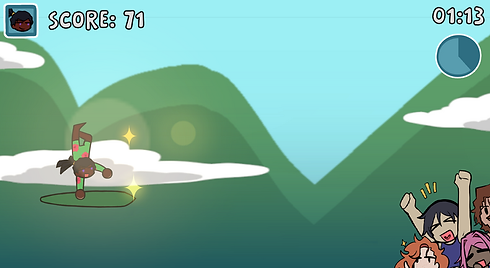
Tricks and Flow
-
Players needed to build enough flow (speed) before attempting tricks.
-
Trick sequences were designed to be short but satisfying, each paired with unique animations for visual reward.
-
Scoring was tied to both difficulty of the trick and flow level, reinforcing skillful play.

Core Gameplay Structure
-
The game was divided into three phases to simulate a surfing run:
-
Paddle Phase – Build initial speed.
-
Wave Riding Phase – Zigzag through waves, avoid obstacles, and gain flow.
-
Trick Phase – Launch off wave peaks and perform tricks by completing button sequences.
This structured design ensured that each run had rhythm: build → maintain → perform.
Control Design
-
Initial prototypes used multiple inputs but felt clunky and unintuitive.
-
Iteration led to a two-button controller (Up/Down with A & D or triggers), making the game easy to learn but hard to master.
-
Trick inputs used sequences of buttons (WASD / D-pad), adding depth and rewarding precision.
Result: A clean control scheme that supported both casual play and high-skill runs.
Iteration and Feedback
The Problem
Early playtests showed:
-
The player controller felt too complex, with too many buttons to manage.
-
Trick execution lacked the visual “punch” players wanted.
The Solution
-
Simplified to a two-button movement system, making wave navigation intuitive while leaving challenge in timing.
-
Added polished animations for tricks, making successful sequences feel rewarding.
-
Tuned flow mechanics so that speed management directly impacted scoring potential.
Result
The game became accessible and fun for new players, but still offered skill depth for repeat play.
Skills Applied
Player Controller Design:
-
Iterated and implemented the final two-button control system for smooth, responsive surfing.
System Design:
-
Balanced flow, trick difficulty, and scoring to reward both accessibility and mastery.
Animation Integration:
-
Designed systems to trigger satisfying animations based on trick input sequences.
Iteration & Testing:
-
Streamlined mechanics through repeated feedback cycles until controls felt natural.
Arcade Design Philosophy:
-
Focused on short, repeatable sessions with “easy to learn, hard to master” gameplay.
Outcome
-
Delivered a fun, competitive surfing game where players chase high scores through flow and tricks.
-
Created a control scheme that supports both casual play and skill-based mastery.
-
Demonstrated how iteration on player controller design can transform the game’s feel and accessibility.
-
Positive feedback highlighted the smooth pacing, rewarding trick animations, and party-style fun of competing for scores.