My Roles
Project Manager
Lead Designer
Lead Programmer (C#)
Developed in
Unity Engine
Duration
7 weeks
Platform
PC
Release
Student Project
July 2024
Intro
Eldoria’s Enchanted Forest is a roguelike-inspired action game where players explore a corrupted forest, battle mutated creatures, and ultimately confront a powerful boss entity. The design combines procedural variety (ever-changing forest layout), combat depth (elemental magic system), and a progression loop (purifying souls to upgrade equipment in a safe village).
Our design goals were:
-
Create distinct playstyles via elemental magic.
-
Encourage repeatable runs with meaningful progression.
-
Deliver a clear objective while maintaining freedom to explore.


Design Approach

Enemy & Encounter Design
-
Melee Enemies – pressure the player’s positioning.
-
Ranged Enemies – force prioritization and movement.
-
The Witch Boss – tests mastery of upgrades and spell usage.
We kept enemy types limited but intentional to ensure that each encounter demanded different player responses.
Core Gameplay Loop
We built the loop around risk vs reward:
-
Enter the forest and fight enemies.
-
Collect Purified Souls as currency.
-
Return to the village to purchase upgrades.
-
Repeat until strong enough to defeat the Witch Boss.
This loop kept runs short, rewarding, and tied progression naturally to combat success.
Elemental Spell System
Electricity – stuns enemies, favoring control.
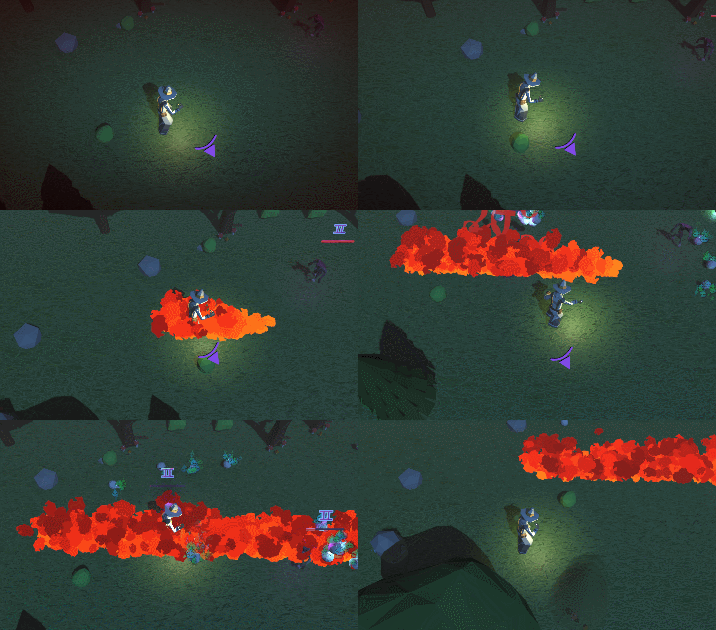
Fire – inflicts burning damage, rewarding aggressive play.
Ice – slows and weakens enemies, encouraging defensive tactics.
Reasoning: This system gave players a strategic identity from the start but still allowed discovery of new spells within runs for variety and replayability.

Iteration and Feedback
The Problem
During playtests, we noticed players struggled with:
-
Progression Direction: Many did not realize they had to move right toward the Witch.
-
Objective Clarity: Players weren’t sure what their ultimate goal was.
Our Solution
To address this, we implemented three major changes:
-
Directional Fog: A subtle fog effect moves left to right, nudging players toward the boss area without explicit handholding.
-
Shop Clerk NPC: Added to the safe village, this character explains the overarching goal and provides narrative context.
-
Tutorial-First Playthrough: Designed the first run to gently guide players through mechanics while surfacing objectives early.
Result: These changes dramatically improved player understanding and flow, reducing confusion and increasing engagement during early sessions.
Skills Applied
System Design: Balanced risk-reward loop, enemy behaviors, and spell progression to encourage replayability.
Technical Design (Unity):Implemented Scriptable Objects for modular spell data (damage, cooldowns, effects). Designed upgrade systems and economy balancing for village hub.
Iteration & User Testing: Gathered and analyzed playtest feedback, then redesigned progression clarity tools (fog, NPC, tutorial).
Collaborative Development: Coordinated with team members across design, art, and programming within a 7-week sprint.
Player Experience Design: Ensured progression pacing, visual cues, and combat variety supported accessibility and long-term engagement.
Outcome
Delivered a playable prototype in 7 weeks with a full loop (combat → progression → boss).
Implemented core roguelike principles (risk vs reward, repeatable runs, procedural variety).
Demonstrated responsiveness to playtest feedback by iterating on clarity and progression.
Eldoria’s Enchanted Forest served as a strong showcase of balancing thematic design, mechanical systems, and player experience iteration under a tight timeline.